



Services we offer:
- Removal of rodents from inside buildings
- Exclusion and rodent-proofing
- REBS Rodent Exclusion Barrier Systems (outdoor)
- Car Corral - design and installation
- Cleanup and sanitizing
- Safe repellents and deterrents
Removing rodents from inside buildings
The rodents are not the real problem but a symptom - their presence indicates breaches in the outermost "shell" of the structure. These points of entry must be found and patched before animals can be removed.
Think of it this way - you're in a little boat and it's filling with water. You want to find and patch the holes before bailing the water, right? The same thing applies when removing rodents from a building - find and patch the holes, then remove the rodents.
Our unique stepwise process
We take a holistic approach to resolving rodent intrusions. We look at the whole picture. We start with a little detective work to find out why they have entered, but we also consider why - what's attracting them to the property.
- Motive. A food resource attracting and supporting the rodents.
- Means. The conditions that provide access to the food.
- Opportunity. The shelter which supports their presence.
The first step, is the inspection. We conduct a thorough perimeter inspection to document entry points as well as any conducive conditions (what's supporting their presence).
Next, we create a report which includes recommended repairs and an estimate for us to complete the work. Most reports include images so our customers can see exactly what we discovered.
Next, we begin the process known as exclusion, which involves making repairs or adding barriers to prevent rodents from intruding.
But what about the rodents that are already inside the structure?
In most cases, we will set live-catch traps where the rodents are most active, like the attic or crawlspace. Sometimes, though, it's necessary to use a one-way device - like a mini-doggy door, which allows the rats and mice to escape safely but not get back inside.
Step One
Inspection
Conduct perimeter inspection. Document conducive conditions and points of entry.
Step Two
Rodent-Proofing
Close entry points. Set live-catch traps or install a one-way device and monitor.
Step Three
Rodent Removal
Using live-catch traps, capture and mark (dye tail) and release. Monitor for repeat offenders.
Live-catch and release
Our unique live-capture and release process allows us to guarantee a structure is 100% rodent-proof.
Rats and mice captured in cage traps are temporarily marked with a non-toxic dye on their tail and then released back onto the property near the building.
This may sound counterproductive, but really, it is the only way to confirm that the rodent-proofing was truly successful.
Rodents are intelligent and remember their travel routes and entry points. What better way to confirm the repairs were successful than to have them “rat-tested”? If the repairs were sufficient, after several days of trapping there should be no further activity or captures.
If rodent activity persists, or if the same marked animal is captured again, additional inspection and repairs will be necessary.
In some cases, when entry points are especially difficult to locate, we may use surveillance cameras and or fluorescent tracking powder to identify hidden breaches and travel routes.
Rodent-proofing is a process, not a quick fix. But once a structure has been properly secured, it can remain rodent-free for years - often decades.
Learn more about the no-poison, no-kill process through our educational video, HERE.
Why poison is counterproductive
Poison to manage rodent populations is a sham! Here's why.
If you have a closed environment - like a building that is sufficiently rodent-proofed, then there is absolutely no reason to use poison or any other lethal control on the exterior.
If a building is not rodent-proofed, no amount of poison or other lethal control measures will protect the structure. In fact, it can do just the opposite.
- The poisoned food inside a bait station is an attractant, drawing rodents and other animals to the property.
- Rats are known to grab chunks of poison and carry it out into the environment, exposing children, pets and other animals to these toxic substances.
- When a poisoned rodent dies within a structure, its ectoparasites - fleas, mites, will move off the carcass in search of another warmblooded host, risking vector-borne zoonotic disease transmission.
- Poisoned rodents don’t die right away - it usually takes a few days, during which they become weak and easy prey for bobcats, fox, owls, hawks, even dogs and cats.
- Rodents found dead or dying in residential yards and public parks can contain high levels of poison. Examples: a roof rat with 36,000 ppb of brodificoum in its system; a dusky-footed woodrat with 6,000 ppb difethiolone; a deer mouse with 2500 ppb bromadiolone. Poisoned prey that could have been eaten by a cat, dog, owl or hawk.
Anticoagulant Rodenticides are the new DDT
Like DDT, anticoagulant rodenticides bioaccumulate - they can remain in an animal’s system for a year or more. One poisoned rat might not be enough to kill a bobcat, for example, but repeated exposure will cause its demise.
Like DDT, these chemicals work through the food web, into ecosystems, from snails and slugs to apex predators. Residuals have also been found in waterways.
The truth is, except for the rare situation, anticoagulants are obsolete. There are safer, more effective and lasting alternatives.
You won’t hear this from the conventional pest control industry, however, because peddling these poisons is BIG business. You WILL hear fear-mongering and proselytizing about how poisons are essential to public safety, BECAUSE, they have to keep people hooked on poison. It’s too lucrative!
Placing poisoned food in containers is not labor intensive - making it REALLY profitable. AND, it does nothing to address the actual CAUSE of an infestation, so repeat business is guaranteed.
SAY NO TO RODENTICIDES!!!
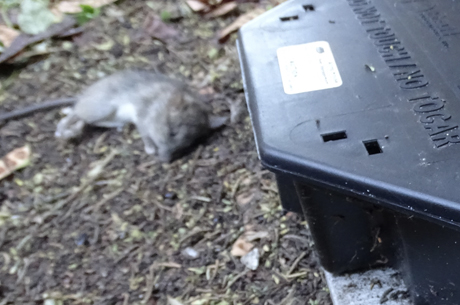
View Album: The Faces of Anticoagulant Rodenticide

A bobcat killed by rodent poison. Its last few moments.
